Covering a classic car properly — protection without condensation
The principle
Breathable rather than waterproof
The enemy of the covered vehicle is not the rain — it is the condensation. In the garage or the hall the temperature fluctuates, the humidity of the air settles on the cool bodywork, and beneath a waterproof tarpaulin this water cannot escape. It stands for weeks on the paint, in the folds of the tarpaulin, on the chrome parts. What was meant to protect preserves the moisture.
A good cover is therefore breathable: it keeps out dust, stray light and curious hands and lets the air circulate so that moisture can draw off. Woven cotton or dense blended weaves with an open construction do exactly this — protection without enclosure.
The inside
Soft, whatever touches the paint
What the cover must withstand on the outside is insignificant beside what it can do on the inside. Every contact between cloth and paint is friction, and grains of dust on the inside work under movement like fine sandpaper. The inside of a car cover therefore belongs in a soft, lint-free cloth without rough seams on the resting surfaces.
The distance matters too: the cover should enclose the vehicle, not cling to it. A cut with some air between cloth and bodywork prevents moisture at the points of contact and lets the cover float rather than chafe. Exactly this measure of air arises only on the original, not from a chart.
The fit
Measured on the vehicle
No classic car is like another — the outgrowth of a radiator mascot here, the spare-wheel bracket there, mirrors mounted later. La Couverta measures every cover on the original: length, height, wheel arches, mirrors, aerial, every outgrowth of the line. From the measurements a pattern arises that follows the vehicle instead of merely covering it.
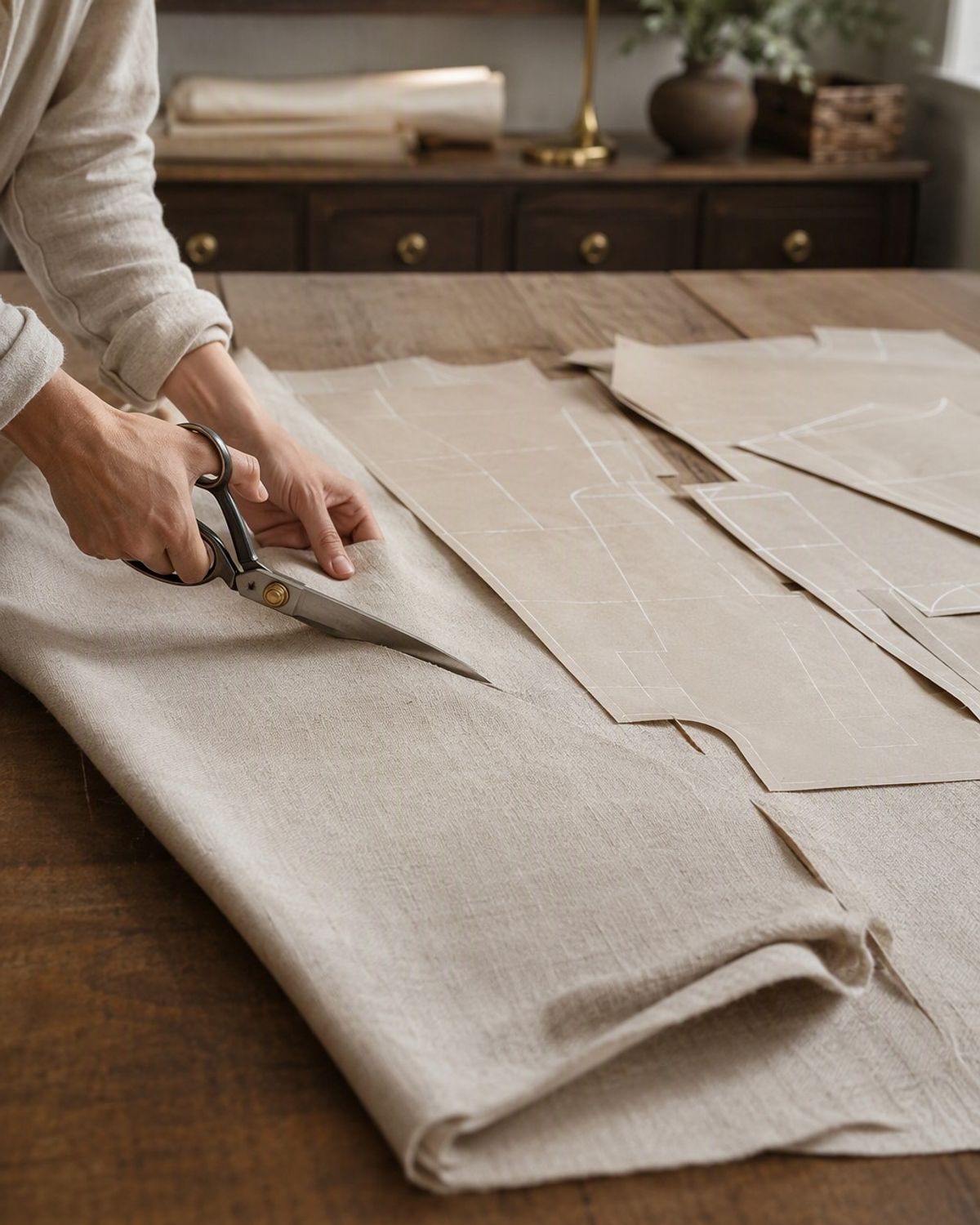
The result lies calmly on the silhouette and reaches to just above the floor without brushing it. There are no mountains of folds at the rear and no tension over the wings — the cover falls as it does because it was cut for exactly this vehicle.
The details
No elastic cords on chrome
Universal tarpaulins are fixed with elastic cords, hooks or lashing straps — and each of these solutions has its price on the vehicle. Elastic cords chafe on chrome and paint edges, hooks seek points of attack at wheel arches and doors, and whatever is drawn taut rubs with every tremor of the hall.
A made-to-measure cover does not need this. It holds by its form, not by tension: with cleanly bound edges, a padded resting strip over the chrome parts and a weight that keeps it in its place. Where fastening is necessary, it lies soft and protected — never directly on bare metal.
Winter storage
The quiet season
Covering belongs to the larger ritual of laying up for winter. The vehicle is put away clean and completely dry — remains of wax and water beneath the cover are poor neighbours over months. The hall itself should be dry and moderately tempered; a cover does not make good a damp garage, it only softens it.
During storage an occasional look is worthwhile: lift the cover, air it, check whether moisture is gathering anywhere. A breathable cover forgives much, but not neglect. In spring it comes off, is aired and — if necessary — cleaned and stored dry until the next quiet season begins.
The difference
Made to measure against the universal tarpaulin
The universal tarpaulin is made for the average vehicle and therefore fits none properly: too long here, too taut there, and everywhere tension and folds where there should be none. It protects against the coarse and harms in the small — the paint, the chrome, the patience.
The made-to-measure cover is the opposite: measured on the original, cut to the line of the vehicle, soft inside and breathable outside, without tension on sensitive places. It is part of what La Couverta understands by the protection of collectors’ pieces — from the vehicle to the grand piano. What else we make for collections is set out on the page Covers for collectors’ pieces.